In product development, we often talk about “features”, but what customers really seek is solutions to their problems, fulfilment of their goals and needs, relief of frustrations and pain points. If we get to those needs early and effectively, we reduce waste, deliver more value and de-risk ourselves by not building something that nobody wants.
Businesses that deeply understand customer needs consistently outperform those that don’t.
According to McKinsey, companies that use customer data effectively outperform peers by 85% in sales growth and 25% in gross margin.(Reference 1: McKinsey Report)
Yet, only 23% of organisations say they are “very effective” at identifying changing customer needs (Reference 2: Forrester Report)
What Are Customer Needs
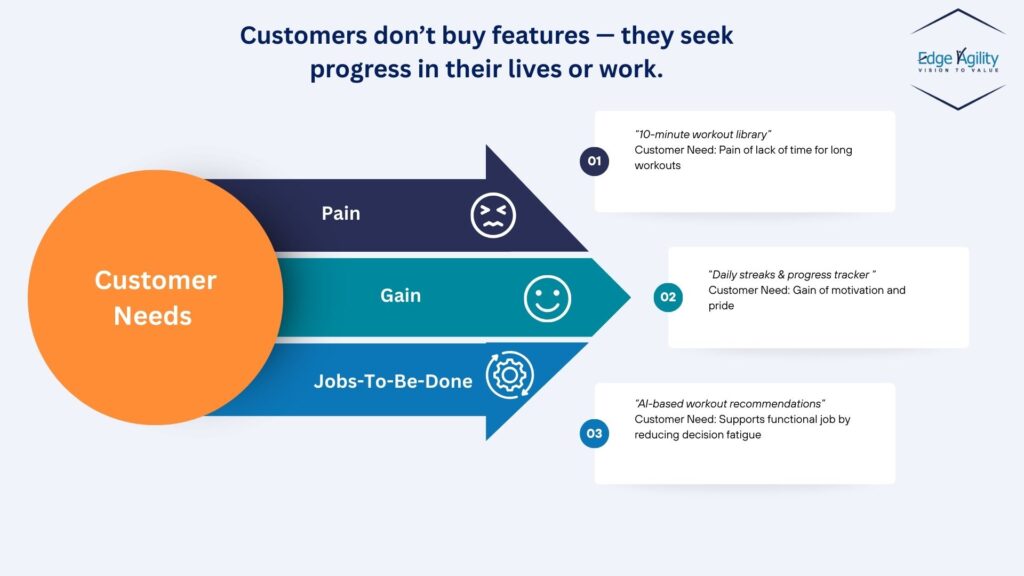
In simple terms, a customer need is something a person is looking for in order to make progress in a context they care about.
It could be:
Pain (something that frustrates or blocks progress), Example: “I get anxious waiting for a delivery because I don’t know where it is.” Underlying customer need: I need reassurance and transparency during the delivery process.
Gain (something they hope to achieve or feel)Example: “I love it when an app remembers my preferences.” Underlying customer need: I want things to be easy and personalised so I can save time.
Job-to-be-done (a practical task) Example: “I need to track my expenses quickly while travelling.” Underlying customer need: I need a simple, reliable way to record expenses on the go.
Emotional job-to-be-done (a feeling or reassurance)Example: “I want to feel in control of my health data.” Underlying customer need:I need confidence that my information is safe and accessible.
Social job-to-be-done (how they’re perceived by others)Example: “I like using eco-friendly products because it shows I care.” Underlying customer need:I want to express responsibility and earn social approval.
Using AI to Discover and Address Customer Needs
In product development, we often talk about “features”, but what customers really seek is solutions to their problems, fulfilment of their goals and needs, relief of frustrations and pain points. If we get to those needs early and effectively, we reduce waste, deliver more value and de-risk ourselves by not building something that nobody wants.
Businesses that deeply understand customer needs consistently outperform those that don’t.
According to McKinsey, companies that use customer data effectively outperform peers by 85% in sales growth and 25% in gross margin.(Reference 1: McKinsey Report)
Yet, only 23% of organisations say they are “very effective” at identifying changing customer needs (Reference 2: Forrester Report)
What Are Customer Needs
In simple terms, a customer need is something a person is looking for in order to make progress in a context they care about.
It could be:
Pain (something that frustrates or blocks progress),
Example: “I get anxious waiting for a delivery because I don’t know where it is.” Underlying customer need: I need reassurance and transparency during the delivery process.
Gain (something they hope to achieve or feel)
Example: “I love it when an app remembers my preferences.”
Underlying customer need: I want things to be easy and personalised so I can save time.
Job-to-be-done (a practical task)
Example: “I need to track my expenses quickly while travelling.” Underlying need: I need a simple, reliable way to record expenses on the go.
Emotional job-to-be-done (a feeling or reassurance)
Example: “I want to feel in control of my health data.”
Underlying need: I need confidence that my information is safe and accessible.
Social job-to-be-done (how they’re perceived by others)
Example: “I like using eco-friendly products because it shows I care.”
Underlying need: I want to express responsibility and earn social approval.
Identifying the why behind the request allows teams to solve the real problem, not just its symptom.
Where AI Adds Value in Understanding Customer Needs
I would love to share a few real-life use cases where Artificial Intelligence (AI) has helped my and my clients discovering customer needs as well as validating these customer needs.
(Please note: I’m not endorsing any specific product or tool. I’m simply sharing my experience with tools I’ve used or am familiar with for different use cases. Technology evolves quickly, and new solutions are emerging every week.)
1. Analysing Open-Ended Feedback at Scale
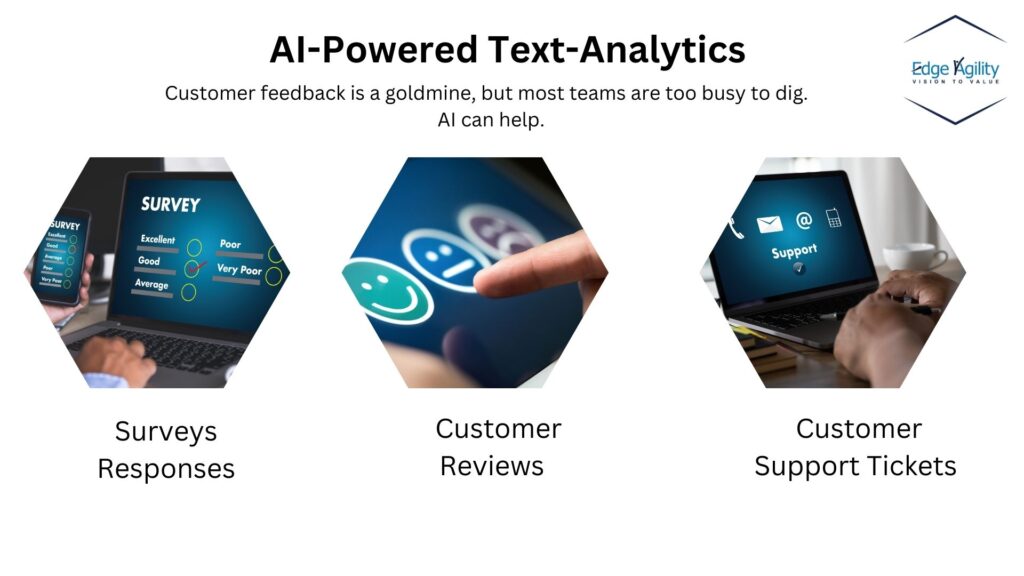
AI-powered text analytics can process thousands of survey responses, reviews, and customer support tickets to uncover recurring pain points or desired outcomes.
Many of the clients I work with already have a wealth of customer feedback, but not enough time or capacity to dig the gold out of it. That’s where AI can make a real difference.
There’s a lot of gold hidden in customer feedback — most teams just don’t have the tools & time to mine it. AI helps you turn that noise into nuggets of insight
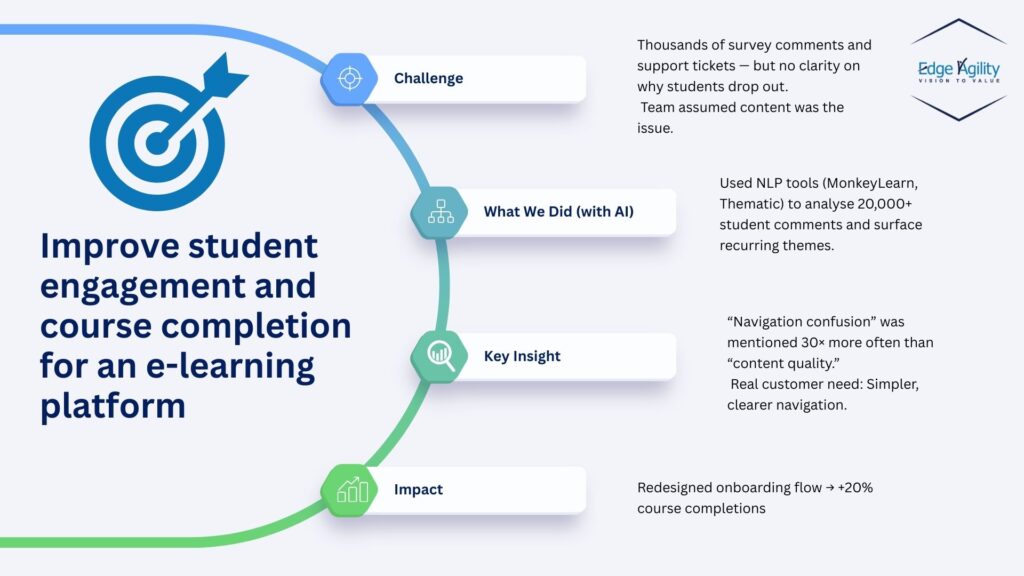
Recently, we worked with an E-learning platform that used Natural Language Processing (NLP) to analyse over 20,000 student comments. The AI revealed that “navigation confusion” was mentioned 30 times more often than “content quality.” Until then, the team had believed that poor content was the main reason for low course completion rates, but the data told a different story.
Tools like MonkeyLearn, Thematic, and Kapiche make this kind of large-scale feedback analysis accessible and fast, helping teams focus their energy on solving the right problems.
2. Detecting Hidden Emotions and Frustrations
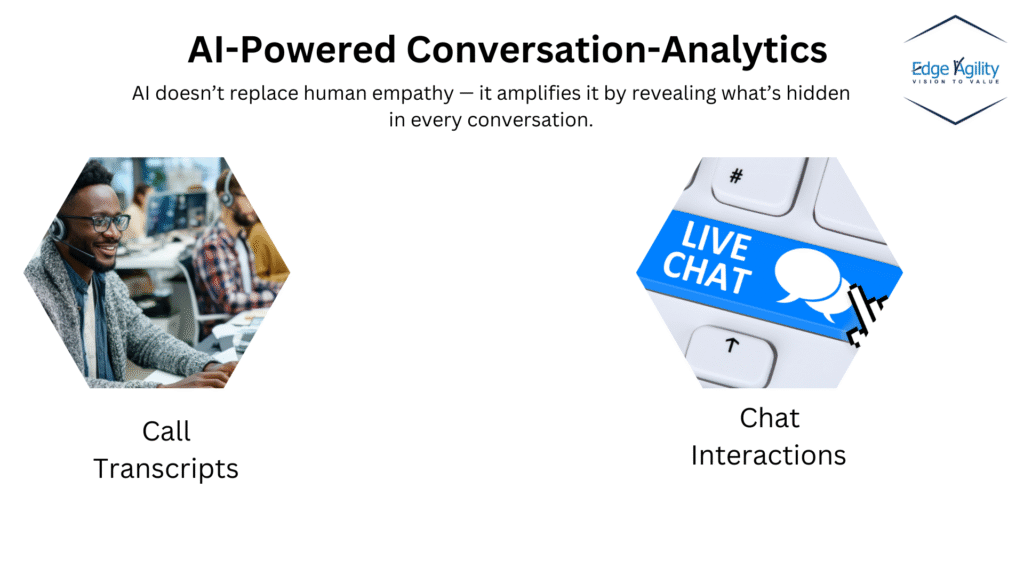
AI can analyse call transcripts and chat interactions to uncover not just what customers say, but how they feel — frustration, confusion, anxiety, or satisfaction. These emotional cues often point to needs that customers can’t easily express in words.
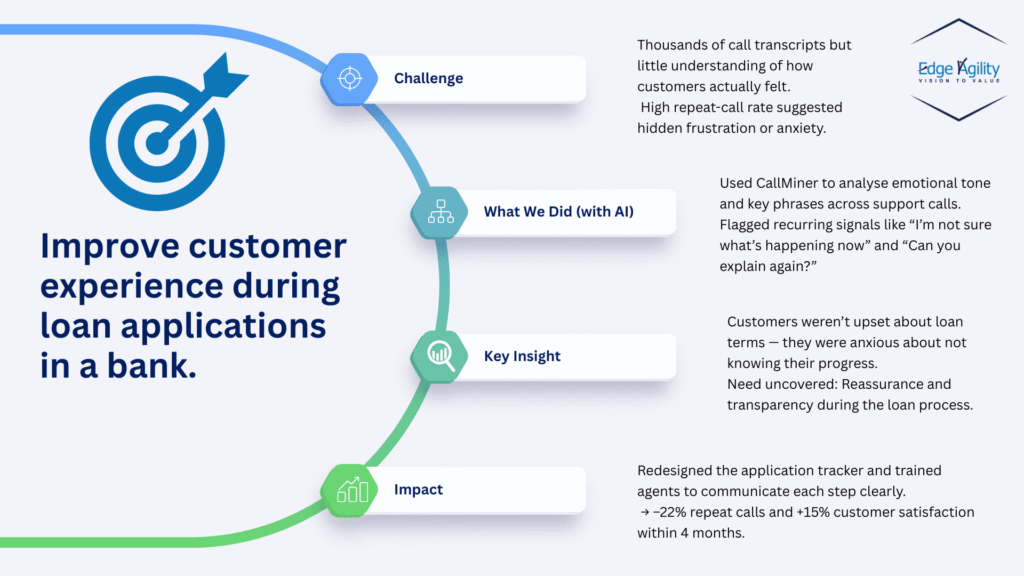
For instance, a banking client we worked with analysed thousands of customer service call transcripts using AI-based sentiment and emotion analysis. The system flagged recurring phrases such as “I’m not sure what’s happening now” and “Can you please explain again?”, both linked to high emotional intensity.
The insight? Customers weren’t upset about interest rates or loan options — they were anxious because they didn’t understand where they stood in the application process. These insights was later complemented by a few customer interviews.
We tried to solve the problem by, redesigning the progress tracker, make it easy to found and and training customer agents to proactively explain each step. Over next 6 months these few steps helped us in reducing the repeat calls by 22%.
Tools like CallMiner can make this kind of emotion and intent detection from transcripts both fast and accurate.
Discovering customer needs is not enough, we need to frequently and regularly validate them as well.
3. Validating Customer Needs using Rapid Prototyping
In my view, prototyping is one of the best ways to validate assumptions, but traditionally, it used to take time.
Let me share how this looked in the pre-AI world.
As a Product Owner or Manager, I’d discuss a problem with stakeholders. These conversations often drifted toward possible solutions. I’d then take that rough idea to my team. If I had a UX designer, great, if not, I’d request design support from another team. After mock-ups were built, I’d take them back to stakeholders for feedback.
In most cases, they wanted rework. This ping-pong cycle could last for weeks -resulting in lost time, lost opportunities, and sometimes, lost morale.
Enter AI-powered rapid prototyping tools like Bolt.new or Lovable
They can turn ideas into interactive prototypes in minutes. This speed allows product teams to gather high-quality feedback immediately instead of waiting weeks. You can also generate multiple design variations to explore different approaches — a real boost to innovation
Real Life Example
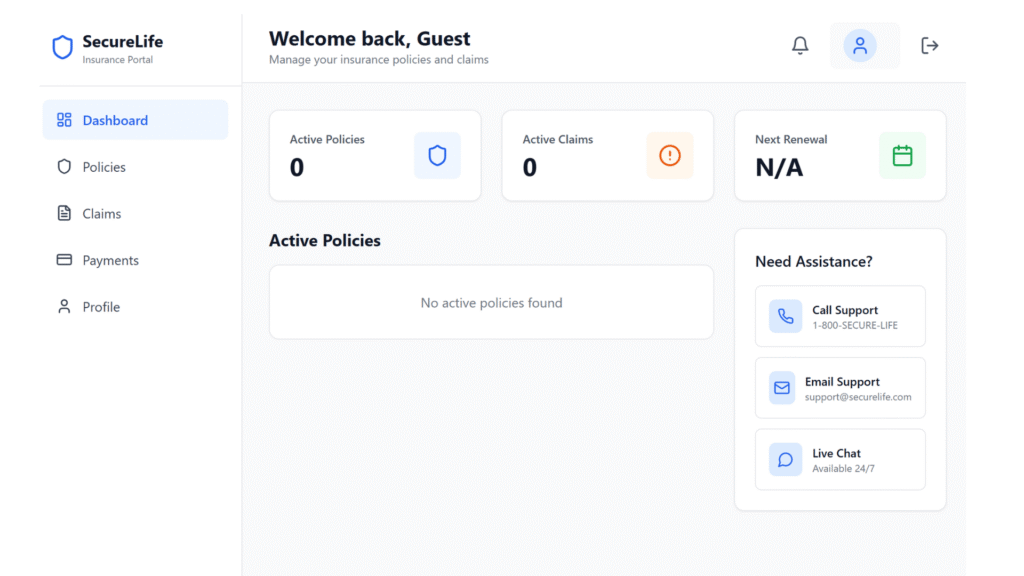
Context: I was helping an insurance client, and the problem we were trying to solve was: “How can customers view and manage their policies without calling customer service every time?”
Our initial solution idea was to build a dashboard application.
Here’s the prompt we used in Bolt.new:
I am a Product Owner at an Insurance company, and I want to design a Customer Dashboard web app where customers can easily view and manage their insurance policies.
The dashboard should allow users to:
View all their active and expired policies (auto, health, home, etc.) in a clean card layout.
See policy details such as coverage amount, premium, renewal date, and claim status.
Download policy documents (PDFs).
Get alerts for upcoming renewals or payments due.
Quickly contact customer support or their assigned agent.
Design guidelines:
Include sample dummy data for 2–3 insurance policies to make the dashboard functional for demonstration.
Clean, modern UI with a professional insurance brand feel (blue/white colour scheme).
Include a sidebar for navigation: Dashboard | Policies | Claims | Payments | Profile.
Add a header with the user name, notifications, and a logout button
Add a summary section at the top showing total policies, active claims, and next renewal due.
Prioritise clarity and trustworthiness — this is for customers who value transparency in managing their policies.
Yes, it’s a long prompt, but I’m a firm believer in giving AI as much context and specificity as possible, especially for professional use.
Within 5–6 minutes, the tool generated a clickable prototype with all the key features we had discussed. The idea turned into something tangible almost instantly.
However, it’s important to clarify that the prototype was not the final product, it didn’t include backend functionality. We positioned it clearly as a validation artefact, not a deliverable.
Stakeholders loved it. Subject Matter Experts suggested a few improvements, which we quickly incorporated into the live prototype. Within a few hours, we had a validated customer need and a shared understanding of what the solution might look like.
Other Practical Use Cases Of Leveraging AI for understanding and validating customer needs
Creating Proto-personas quickly
Building/Enhancing Customer Journey Maps and finding pains/gains
Predictive Analysis using historical data
Generating Hypothesis
And many more….
Bringing It All Together
AI has changed how we understand and validate customer needs, from analysing feedback to prototyping ideas in minutes. But as powerful as these tools are, they don’t replace human curiosity, product sense, or contextual understanding. AI can surface patterns, but only humans can connect them to purpose.
AI gives you speed and scale ,but insight still requires empathy and experience
AI gives you speed and scale ,but insight still requires empathy and experience.
Lavaneesh Gautam
As product professionals, our job is not to build what AI tells us, but to use it to ask better questions, learn faster, and focus on solving real customer problems.
SignUp For Our Newsletter - Vision To Value
For Practical and actionable Nanotips to deliver value to your customers, users and organisation.